

LINUX Air Combat
Originally released: 2015
Latest release: v9.75
Linux Air Combat is a new, free, open source combat flight world war 2 simulator for the LINUX community.
Linux Air Combat is now the world’s leading free, open source combat flight simulator. Versions have changed rapidly as features and aircraft were added.
Written specifically for LINUX with no need for emulation of Microsoft “Windows”. Among the high-performing few written specifically for LINUX.
Linux Air Combat is unique because it runs nicely even on modest PCs, and because the source code is very clean, well organized, and is built entirely on a foundation of well-known, popular, universally supported, open source components that are available on virtually every popular distribution of LINUX.
In classic real-world aircraft, Linux Air Combat or LAC’s flight controls generally begin to feel “heavy” at extremely high speed, with some aircraft suffering more than others from this “compressibility” effect. For example, the early-war P38F “Lightning” becomes almost uncontrollable in a high-speed dive, but the late-war P38L version can recover from that condition by activating the same simulated “dive flap” that was used in the actual aircraft.
Flight speeds tend to increase with altitude as thinner air (and correspondingly diminished air resistance) interacts with various types of superchargers able to scoop enough air into greedy engines to sustain full power up to their respective height limits. On the other hand, the thinner air at high altitudes degrades climb rates. Eventually, above well-researched high altitude limits, even the aircraft with the best superchargers begin to wheeze and gasp for air, resulting in diminished overall performance.
Some of the simulated aircraft are equipped with “Speed Brakes”, or “Dive Brakes” that can help them to suddenly decelerate (or at least to maintain reasonable control at extreme speeds). Some are equipped with “War Emergency Power” settings that are capable of extracting the utmost power from their engines for a few minutes (at the cost of massive fuel consumption and the likely need for an overnight overhaul by the ground crew afterward). Some are equipped with primitive, single-level flaps, while others are blessed with several levels of flaps. Some are equipped with tail gunners, and some absolutely bristle with defensive guns automatically firing as needed toward airborne threats in all directions. Some have fearsome, forward-firing cannons that can shred opponents, while others are armed only with small, lightweight machine guns that demand sustained aiming and shooting before significant damage can be inflicted. And exactly as one might expect, all of the aircraft that can lug heavy bombs or rockets suffer diminished performance until they can shed this extra weight. All of these differences are historically based, according to the best available records.
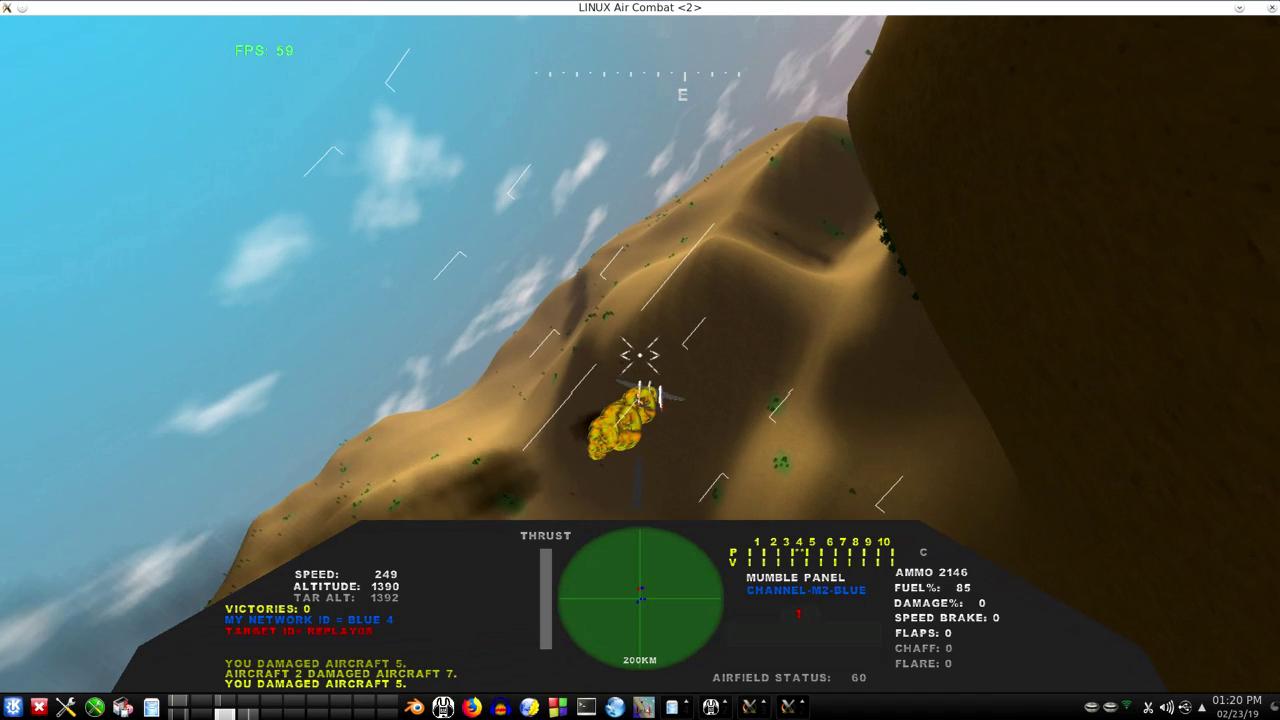 Linux air combat’s cockpit is completely standardized, so no matter what kind of airplane you choose to fly the cockpit will look exactly the same for the selected mission. Furthermore, Linux Air Combat’s instruments look more like a modern, digital, “glass cockpit” than a World War II warbird. That choice has helped to make it easier to learn LAC than other sims that move instruments around to match each simulated aircraft. It also contributes to LAC’s remarkably high frame rate and the silky-smooth sensation of flight
Network Integration
Linux air combat’s communication and network features are arguably among the very best of all online flight sims, even by today’s standards.
Linux Air Combat is all about multi-player, Internet-based missions. Of course, that will require an Internet connection. Linux Air Combat’s network bandwidth demands are modest, too. Even if you rely on an old 56Kbps(as if!) modem-based connection, you ought to be able to participate in the 10-player online missions without experiencing undue “lag” or “warps”.
One of Linux Air Combat’s most important innovations is the “Network Router” that’s visible near the upper right corner of the cockpit instrument panel in all of the online missions. Like all multiplayer network flight sims, LAC players send and receive frequent “network telemetry packets” to one another in order to locate themselves relative to one another and to the simulated geography. On the Network Router Panel, two rows of ten little light bulbs blink on and off to represent incoming telemetry or voip packets from the ten players that can participate in each of those missions. The server relays incoming packets from nearby participants more frequently than from distant participants. Accordingly, a quick glance at the Network Router Panel can reveal the number of active mission participants, as well as their relative distance from the player, because the lights corresponding with nearby participants will blink much faster than distant ones. When any of them begins to speak on the simulated, inter-player voice radio, his corresponding “Voice” light bulb illuminates.
During online missions, Linux Air Combat’s most basic tool for interplayer communication is its powerful “Morse Code Radio”. By pressing the “Caps Lock” key, players toggle their keyboards back and forth between the usual flight mode and “Morse Code Radio” mode. When the Morse Code radio is active, printable keystroke characters are transmitted, received, and displayed, one by one, across a separate little cockpit panel that illuminates when in use, where every player in the mission can see them. Most online flight sims have something like this, permitting players to send text messages to one another, but in a small gesture illustrating the care and quality with which LAC has been groomed, Linux Air Combat goes farther, accompanying every transmitted character with the authentic beeps and tones of real Morse Code! If Morse Code radio traffic ever suffers from congestion or deliberate interference, convenient function keys allow automatic muting and unmuting of the current sender, or of the entire BlueTeam or of the entire RedTeam, allowing clear reception of the remaining information.
For voice communication, the Linux Air Combat community relies on the free, open source, well-known “Mumble” Voice-over-IP (or “VOIP”) application. As a companion or “helper” program, Mumble’s use is optional, but it is highly recommended.
Linux Air Combat and Mumble work hand-in-hand. Linux Air Combat’s remappable keyboard controls and cockpit panels work in cooperation with a powerful, free Mumble Server available online at LinuxAirCombat.com. The combination makes it easy to meet other LAC fans and to arrange cooperative or competitive interaction in any of the three supported missions. The Linux Air Combat Mumble Server even includes dynamic, web-based tutorial help focused on each of its rich set of channels dedicated to support, mission teamwork, or just chatting with other flight sim fans. That online, Mumble-based help will even display a convenient map of LAC’s keyboard, numeric keypad, and joystick controls for reference during missions!
When flying in one of the multiplayer missions, the interaction with Mumble becomes even more powerful, because Linux Air Combat’s cockpit panel illustrates Mumble actions as if it were an aircraft radio, revealing all transmission, reception, and channel-changing activities of everybody in the mission. LAC commands Mumble to switch channels automatically, as the user changes missions or teams. During missions, players that earn a good reputation can even be “promoted” by their peers, allowing them to take mission-wide command of the team’s use of Mumble channels and ensuring that strategies are appropriately communicated among team members, but kept private from the opposition.
Under the leadership of a promoted player, this team-wide integration with Mumble is really impressive and amazing to experience. The first time your entire team simultaneously switches to an obscure Mumble channel for a more private conversation, away from the eager ears of the enemy, makes private plans and then, exactly two minutes later, simultaneously and automatically switches, all together, back to their team channel, you get an idea of the care and detail that went into Linux Air Combat’s player management.
Players that have been promoted into team leadership can issue team-wide commands to switch everybody to an obscure, private channel, to the team’s “MissionCast” channel (where all conversations are public to both teams), to the team’s “TeamCast” channel (isolated from the other team), or even to the system-wide “Root” channel (where new users, looking for action, might be recruited). All of these team-wide, channel-switching commands are transmitted over the Morse Code radio, and only players that have been promoted can issue them. LAC’s promotion system is elegantly simple: No player can promote himself, but any player can promote any team-mate just by transmitting a specially formatted Morse Code Radio message. Once a player is promoted, his promotion remains until he is killed or leaves the mission, giving team-mates an extra incentive to protect him (and giving his opponents extra motivation to target him).
This partnership between Linux Air Combat and Mumble even simulates radio chatter with a “forward observer”whose automated voice rewards players for tuning to proper mission channels with periodic espionage updates on enemy airbase damage and maintenance activity!
Online Documentation
Linux Air Combat is very well documented online, and the best of that online documentation is fully integrated into the sim. Hundreds of “YouTube” video clips instruct beginners in every aspect of downloading, compiling, installing, configuring, and flying LAC. High-quality online resources are available in response to a single mouse click from Linux Air Combat’s main menu, immediately invoking the user’s designated web browser with specially optimized web pages for training.
Selecting one of LAC’s 54 available aircraft is like touring a warbirds museum: essential characteristics are displayed in tabular form while a rotating 3d image dominates the display. For each aircraft, a prominent “CHECK FOR MULTIMEDIA” button leads to at least one corresponding YouTube documentary video clip. Players can spend hours and hours enjoying all of the aircraft in this virtual warbirds museum mode.
Linux Air Combat’s lively online “forums” are loaded with help and associated links. LAC’s main web page is easily found in response to a “google” search, or it can be directly located through the prominent links at the top of the well-known “AskMisterWizard.com” website.
Getting Started
Offline tutorial missions allow you to practice gunnery against a variety of “bot” opponents. Don’t expect the “bots” to be very intelligent, though as they are very basic. Offline missions can get you ready for the real fun of Linux Air Combat: the two-player “Head to Head” mission, or the three online, server-based, multiplayer missions.
Online, Multiplayer Missions
As soon as you start one of the online, multi-player missions through the free server, you will know that you’re doing something more sophisticated! Scripted radio dialog narrates the tactical situation into your headset, informing you of your team affiliation, mission ID number, and radio channels in use by your team-mates. If any of the ten possible human players is flying in the same mission with you, you’ll see corresponding blinking lights on your “Network Router” panel.
There are three types of online missions. All three missions are similar in that they all obey 12 specific rules which are automatically enforced and carefully contrived to create an environment of realistic conflicts and tactics. Everything “just makes sense”. In fact, the environment makes so much intuitive sense that you probably won’t even need to remember these twelve rules, but here they are anyway:
Twelve Uniform Characteristics of Linux Air Combat’s online, multi-user missions:
1 of 12: Players are divided into two teams, known as “Red” and “Blue”, respectively. Cockpit icons and text representing mission assets or players are colored red or blue to match.
2 of 12: Each team has several air bases: One “HQ” airbase that’s quite close to the opposition, a second airbase that’s a little farther away, a third airbase that’s still farther out, a fourth airbase for bombers that’s about 100 kilometers distant, and a fifth airbase, about 150 kilometers away, that is unique in that it is the only one that can load the massive B29 heavy bomber with its full bomb load. BlueTeam airfields are on the West side of the world, while RedTeam airfields are on the East.
3 of 12: The objective is to destroy the enemy HQ airbase with some combination of bombs, rockets, cannons, and/or machine guns, while protecting your own HQ airbase
4 of 12: HQ airbases defend themselves with powerful ground-based anti-aircraft guns. A battleship is moored alongside each naval HQ airbase, and its guns contribute to area defense. Destruction of the HQ airbase is not complete until the accompanying battleship is destroyed too.
5 of 12: As HQ air bases are damaged, their defensive guns become less and less effective until they fail entirely.
6 of 12: All aircraft are equipped with RADAR receivers that illuminate the positions of Blue team members with big blue dots, and illuminate the positions of Red team members with big red dots. Players flying in complex terrain can hide from opposing RADAR by descending deep down into canyons and valleys.
7 of 12: RADAR updates come frequently from undamaged HQ airfields, but if an HQ airbase becomes heavily damaged, those updates cease, and members flying for the corresponding team go RADAR “blind”.
8 of 12: Undamaged HQ airbases are able to fully support and maintain all 54 types of available aircraft. However, if a team suffers heavy damage on their HQ airbase, late-model aircraft suffer diminished service support, forcing team members to choose from one of the less powerful, early-war aircraft or to take their chances in a late-war plane that isn’t properly fueled or armed. Accordingly, players can deny their opponents access to the best planes by damaging their HQ airfield.
9 of 12: As long as the HQ airfield isn’t too damaged, players that run low on fuel, run low on ammo, or suffer aircraft damage can return and land there to get refueled, re-armed, and repaired. However, that re-arming, refueling, and repair activity ceases entirely if the HQ airfield is heavily damaged. If the HQ airbase is too damaged to offer these services, the player is forced to land at one of his more remote airfields.
10 of 12: Damaged HQ airfields are automatically repaired by surviving ground personnel. Repairs are accelerated if nearby airspace is dominated by friendly aircraft. Repairs are decelerated if nearby airspace is dominated by hostile aircraft.
11 of 12: Because the HQ airfields are dangerously close to the opposition, heavy bombers that take off from the HQ airfield are only loaded with 50% of their maximum bomb load. Bombers that take off from their secondary airfield are loaded with 75% of their maximum bomb load. Only the airfields that are farthest removed from the battlefront are equipped to load heavy bombers with 100% of their maximum bomb load.
12 of 12: As in the real wars of history, LAC’s combat is enriched with a healthy dose of random luck. Sometimes an attack or a defensive move will benefit from unpredictable surprises. These are completely random, not favoring either side. Over the long run, everybody benefits equally from these random surprises, but in the short run, they guarantee that nobody can really be completely confident of the current situation.
Three Different Types of Online Missions
Three online, multiplayer missions are all fairly similar. However, there are some differences.
Mission #1 takes place in a beautiful island/seascape terrain. A nearby battleship fortifies base anti-aircraft defenses. Upon entry into the mission, all players are nearly out of fuel. Consequently, they are immediately forced to land, obtain fuel, and then take off. This ensures that much of the activity takes place at low altitudes, and players just entering the battle tend to be vulnerable to “vulchers” that may be loitering above, waiting to pounce. After each sortie, players land for repairs and to replenish fuel and ammunition. If they bring their aircraft home without damage and with fuel reserves, they don’t need to wait very long. However, players that get themselves killed or bring back a heavily damaged airplane must re-start with no fuel or ammo, and must wait helplessly on the ground, at risk of attack, while their ground crews struggle to get them ready to go again.
Mission #1 is among the more sophisticated and challenging of the three mission types. You may find experienced LAC players here, and the competition can be brutal!
Mission #2 takes place in a desert terrain, far away from oceans and battleships. The terrain includes dramatic, deep canyons, valleys, and cliffs where airfield-based RADAR cannot penetrate. Accordingly, popular tactics within this mission include low-level attacks that are invisible to RADAR. As with MissionNetworkBattle01, upon entry into the mission, all players are nearly out of fuel. As a result, they are forced to land, obtain fuel, and then take off, ensuring that much of the activity takes place at low altitudes. Players just entering the battle tend to be vulnerable to “vulchers” that may be loitering above, waiting to pounce. When players land for repairs and to replenish fuel and ammunition, they are especially vulnerable. If they bring their aircraft home without damage and with fuel reserves, they don’t need to wait very long. However, players that get themselves killed or bring back a heavily damaged airplane must re-start with no fuel or ammo, and must wait helplessly on the ground, at risk of attack, while their ground crews struggle to get them ready to go again.
MissionNetworkBattle02’s HQ airfield defenses are a little less vigorous than MissionNetworkBattle01, because victory requires only destruction of the runway facilities without also destroying a battleship. Accordingly, these encounters can be a little less time-consuming. However, the complex terrain allows low-level tactics beneath RADAR level, so tactics can become a lot more devious and it’s always necessary to keep a wary eye open for opponents coming in too low for RADAR detection. Fortunately, pilots can ask HQ radio controllers to send them a report, by voice radio, revealing the last known position of designated aircraft. Those reports, based on ground observer activity, aren’t as timely or as accurate as RADAR, but they can be very useful in the location of opponents that cannot be tracked by any other means.
Mission #3 takes place in the same beautiful island/seascape terrain that is used in Mission #1, but all players enter the mission with a full tank of fuel. Accordingly, nobody is forced to land for fuel, and altitudes tend to be higher. “Vulching” opportunities are far less frequent in this battle. Furthermore, combat damage isn’t quite so quick to disable critical flight functions. Refueling, re-arming, and repair activities are always very quick in this mission, and so pilots don’t suffer the perilous delays that characterize the other two missions when returning with low fuel or heavy damage. Accordingly, this mission tends to be a little easier and less frustrating for beginners.
Finding Opponents and Allies In Flight
Linux Air Combat’s online, multiplayer missions can become frantic and complex, and new players may become overwhelmed with the rapid flow of information. Military strategists have long recognized this aspect of real battles, referring to it as the “fog of war”.
Finding opponents and allies in flight can be a great challenge. The process works sensibly and intuitively, relying on all of those tools and common sense exactly as one might expect, but you will get better at it with practice!
Seven Categories of Online Tactics
Online tactics tend to fall naturally into seven different categories. In the following little sections, this review will mention those categories and the challenges associated with each:
Tactic 1 of 7: Fighter Versus Fighter
It can be great fun just to jump into a nimble fighter plane and skitter off into the skies looking for skilled enemy fighters that want to “dance”. LAC’s Fighter-versus-fighter encounters constitute the pure essence of the sim, and this is the kind of exercise that most players find liberating and exciting. Strategically within LAC, eliminating an enemy fighter doesn’t contribute directly to winning the battle; no “points” are won and nobody is crowned an “ace” for five victories, but the elimination of an enemy fighter plane DOES take the pressure away from your team-mates in bombers or otherwise attacking enemy headquarters. It can be especially useful to shoot down an enemy fighter that has climbed to a threatening altitude, because otherwise he would be likely to shoot down one or more of your bombers.
Tactic 2 of 7: Bombing
LAC’s suite of bomber aircraft includes “heavy” bombers, “medium” bombers, and “dive” bombers. All are capable of inflicting significant damage on an enemy airfield, and all must be considered an important threat if they are targeting your own HQ airfield. For example, a single B17, B24, or B29 can wipe out most of an airfield’s defenses in a single pass if it is skilfully flown and arrives over target, at an ideal bombing altitude, with its full complement of bombs.
However, this is difficult because it requires a long, heavily-laden flight from the most distant airfields, and the bomber is slow to climb or maneuver whenever it is so laden. Incoming fighters fly much faster than most bombers, and they can be highly motivated to overtake and shoot at them. If a bomber is damaged during the flight, it will probably be unable to hold its altitude unless it discards some of those heavy bombs. Accordingly, it will usually require several bombers or several distinct bombing runs from a single bomber to destroy the enemy airfield. And as soon as a bomber takes off on an attack run, enemy fighters are likely to be alerted by their RADAR equipment and may launch deadly opposition.
To counter these enemy fighters, LAC’s bombers are all equipped with defensive guns that automatically shoot at opposing aircraft within gunnery range. In general, bigger bombers have more of these guns, but they need them because they are bigger “targets”, and they can’t maneuver very well to avoid incoming bullets. The smallest bombers typically have only a tail gunner with just one or two light-weight, rear-firing weapons. Accordingly, they aren’t as effective at shooting down opposing fighters, and must rely on a combination of defensive, turning maneuvers and their defensive auto-guns. Furthermore, fighters that damage bombers also weaken those defensive guns and slow the bomber down, so a damaged bomber is less able to defend itself and becomes a more attractive target for opposing fighters.
It can be difficult to hit a target with a World War II era bomb. The most accurate method is to “dive” almost straight down toward the target, waiting until the last possible moment before releasing the weapon and then pulling violently upward to avoid the resulting blast or crashing into the ground. To facilitate this kind of pinpoint bomb aiming, LAC includes several “dive bombers” that were specially built with “dive brakes” to help them control their speed in the downward plunge, giving the pilot more time to aim. (It’s possible to make an effective “dive bombing” run in other types of aircraft, but without dive brakes the pilot has a lot less time to aim and runs a much higher risk of crashing). Dive bombing can be developed into a very accurate, very effective skill. However, because dive bombing brings pilots down to low altitudes, dive bombing is a very risky business if the airfield’s main anti-aircraft guns are still at full strength!
Another bomb aiming method is known as “level bombing”, and it can be done from higher, safer altitudes beyond the 15,000 foot reach of airfield gunners. LAC provides special tools to aid in this exercise, emulating what came to be known as a “Norden Bombsight” in World War II. Bomber pilots can switch into “Map Mode” by pressing the “M” key on their keyboard, whereupon their display is replaced with a scrolling map of the terrain below. The player’s aircraft is always located at the exact center of this map, and a moving little “pipper” marks the spot on the ground where a bomb would be likely to hit, at the end of its fall sometime in the future, if it were to be released immediately. Accordingly, heavy bomber pilots that approach their targets can switch into this “Map Mode” and then just use that “Continuously Computed Impact Point” pipper to fly to the proper location before dropping all of their bombs. The impact point prediction is only accurate when flying within carefully calibrated speed and altitude limits, as described in text that is displayed at the bottom of the map when the Norden Bombsight is active.
Because battleships are moored perpendicular to runways, it’s usually best to launch bombing attacks from two different directions; with one thrust along the length of the runway and a second, perpindicular thrust. Due to their increased accuracy, dive bombers are especially useful when attacking battleships. However, it’s usually best to keep your dive bombers away from HQ airfields until after high-altitude, level bombers have weakened the opposing anti-aircraft guns.
Tactic 3 of 7: Bomber Escort
Fighters can protect the bombers on their own team by flying nearby, above them. From that position, they can see enemy fighters that try to attack. This is especially effective if the enemy fighters try to climb up into the bomber formation from their own airfield below, because the climb tends to slow them down, allowing the higher-altitude, defending fighters to dive on them from optimal positions with high-speed, slashing passes, zooming back up to high safety afterward. Bomber pilots like to see fighters accompanying them in this way, and history shows that escorted bombers were far more effective.
However, both bombers and nearby fighters can suffer terribly if opposing fighters somehow get to a higher altitude before making their attack runs. Accordingly, it’s important for escorting fighters to keep a wary eye on the skies above, and to make every attempt to draw such attackers away from the bombers.
Tactic 4 of 7: Bomber Intercept
When one or more incoming bombers target your HQ airfield, a “Bomber Intercept” mission is appropriate. In this circumstance, you take off in a heavy-hitting airplane that can climb quickly up to the bomber’s altitude, or higher, before the bombers can arrive. Airplanes with powerful guns work best, because at your first opportunity you’ll want to start shooting. Big, lumbering bombers are fairly easy to hit, but they can absorb a lot of punishment before they are destroyed. Fortunately, bombers are usually so heavily loaded that even a little bit of damage can cause them to begin to lose altitude, which in turn can force them to discard some of their bombs before they can get to their target location. Every time you can weaken a bomber like this, you are giving your HQ airfield a better chance to prevail.
However, all of this is vastly complicated by the defensive “autogunners” with which bombers are equipped. Those guns can be deadly! It is especially dangerous to try to attack a formation of bombers while slowly gaining on them from directly behind, because bomber crews generally put their best-aiming crewmen into the “tail gunner” position, on their heaviest guns. When attacking a self-defending bomber, you can maximize your odds of survival by keeping your speed very high and attacking from unpredictable angles (like diving from straight above, or coming in with a violent, “slashing” vector from the side). Do not linger within range of their guns; keep moving. It’s a lot safer to make several quick, short, high-speed firing passes than to try to hammer them to death with a single, sustained onslaught. It’s also a good idea to attack with a “wingman”, so that the opposing gunners are forced to split their firepower.
One airplane deserves special consideration in this context: The German “ME163 Komet” is a tiny, rocket-powered interceptor that was specially built for bomber intercept missions. It’s rocket engine can quickly accelerate it to extreme altitudes and speeds, and its big 30 mm cannon can shred even a heavy American bomber with just 2 or 3 hits. However, this airplane is very challenging because it carries only enough rocket fuel for about 7 minutes of full-power flight, and it carries only enough bullets for about 10 seconds of firing. Accordingly, it has no ammo to waste, and it is really only good at hitting big, fat bombers. Furthermore, this airplane doesn’t carry much armor to protect the pilot, it is full of dangerous, explosive rocket fuel, and it requires a very complex, time-consuming process for fueling up. Use it with prudence!
Tactic 5 of 7: Defensive Combat Air Patrol
Sometimes it makes sense just to circle your own HQ airfield, a few thousand feet up, keeping a wary eye out for incoming opposition. Ideally your altitude will be superior to the attackers, so you can dive on them at high speed and blow them out of the sky. Another option is to circle your own airfield in a heavy bomber, so that your autogunners work in harmony with your HQ ground guns to defend your airfield. Either way, if your own airfield is damaged, the ground personnel tasked with repairs will work with much greater enthusiasm and speed if they know you are dominating the skies above them with your friendly aircraft. This can significantly accelerate repair of your HQ airfield after it has been damaged. Sometimes this can turn the tide of the war in your favor!
Tactic 6 of 7: Offensive Combat Air Patrol
One of the most exciting and rewarding activities is to circle above an enemy airfield, watching for airplanes taking off. This is dangerous if the enemy still has active anti-aircraft guns, but not all airfields are so equipped, and even HQ airfields suffer from weak defenses if they are heavily damaged. In these circumstances, you can simply “vulch” the opposition while they are low, slow, and helpless. It is not uncommon to gain several quick victories, one after another, in this circumstance. (Conversely, if you are being “vulched”, you might consider taking off from a different airfield…) Furthermore, if the enemy airfield below you has suffered damage, their repair crews will be intimidated by your presence while you dominate the area, and they won’t attempt to make repairs until after you leave or are driven off.
Mission type 7 of 7: Strafing
After dropping bombs and rockets, your remaining machine guns and cannons can still be used to attack enemy HQ facilities on the ground. This is known as “strafing”, and some aircraft are better at it than others. In particular, fighter airplanes that are cannon-equipped, or that are armed with large numbers of forward-firing machine guns can devastate ground facilities.
The heavily armed North American B25 “Mitchell” medium bomber is especially powerful in this role, as it was in World War II’s Pacific theatre of operations. Strafing an undamaged enemy HQ airfield is extremely dangerous, however! This is best done only after the airfield has been weakened. Strafing is often used to “finish off” the enemy, during the final phases of an attack. It can be very satisfying to shred enemy HQ airfield facilities until a violent explosion and a fanfare of victory music declare your ultimate success!
LAC is not without its quirks. Much of the logic has been deliberately oversimplified in order to maximize frame rate and to make it easy to learn. For example, you cannot see incoming bullets, cannon shells, rockets, or missiles in any of the online, multiplayer missions. In fact, although the invisible bullets coming from human opponents behave as directed by the opposing person, bullets coming from automated “bots” in bombers or from airfields are really just mathematical rules, like rolls of an imaginary pair of “dice”. The odds of taking a hit can be diminished by “jinking” or by flying at extreme speeds or from bizarre angles, but you aren’t really “dodging bullets” with that process; you are just playing the “odds” versus the sim’s brutally simple “risk” mathematics.
The “Artificial Intelligence” used by LAC’s “bots” is not very sophisticated. You’ll see bots doing stupid things from time to time. You’ll find LAC a lot more satisfying if you keep in mind that the primary focus is online, multi-player, World-War II combat simulation.
LAC’s missions support a maximum of only 10 players. Although that’s more than most other combat flight sims not assessing a monthly fee, whenever more than 10 players are connected to the server, the excess must start another mission. With just three online missions exposed in the menus, you might think that the entire LAC community would be limited to a total of 30 simultaneous players, but that’s not the case. LAC’s server divides the LAC community into as many as 32 “Realms”, each of which can support three simultaneous missions, each with as many as 10 players. Each of those Realms is completely isolated from the other Realms. This means that the LAC community can grow to support as many as 960 simultaneous players through the current server, but every player must choose the single “Realm” in which he will fly.
Being new, LAC still has some bugs. When you discover one, a polite email message to “webmaster@AskMisterWizard.com” will get the attention of the developers and will likely result in a fixed version.
The “LAC Community”
Because Linux Air Combat is new at the time of this writing in late April of 2020, the LAC community is small, and it is focused on just one server and just two Realms, to help users find one another within that small community. (Players wishing to participate are advised to install “Mumble” and just to “hang out” in the main Mumble channel at LinuxAirCombat.com until somebody else shows up and says he wants to fly. Better yet, recruit a friend and get him to join in!)
If you find that you are the only player in an online arena, the other nine player positions are automatically staffed by bots managed by your own aircraft. The bots will use the best of their limited intelligence to provide interesting targets for your target practice exercises. As soon as another “Sentient” online player enters your arena, all of the bots will go into their “stupid” mode and simply climb away into the distance in order to help you focus on human opponents.
Gun Camera Films and Server Missions
Online players can ask the LAC server to record their mission activities for subsequent online replay. This is done by pressing the keyboard’s “C” key to commence recording, and pressing “C” again to command the server to stop recording. If the recorded activity turns out to be particularly fun or interesting, the player can send an email to “webmaster@AskMisterWizard.com” to request that it be replayed in one of LAC’s 32 distinct “Realms”. Once that is done, players can fly within the recorded environment, even re-recording it with additional changes. A growing library of these player-generated Server Missions is already available, and the Server admins are pleased to activate them upon receipt of an emailed request.
Among LAC’s 32 distinct Realms, Realm “0” gets special attention. Within that Realm, the LAC Server automatically hosts the best of these special, pre-recorded “Server Missions”, in which fleets of bombers attack opposing airfields. Sometimes these bombers are opposed by interceptors. Sometimes the interceptors are shot down by bomber escort fighters. These pre-recorded missions provide an intense, persistent experience even if no other human players are active, since the pre-recorded aircraft fly formations that were actually flown by skilled human players, according to devious and dangerous strategies. Network players can join these Server Missions at any time, joining, escorting, or opposing the automated aircraft. Damage inflicted on enemy facilities (and repairs to your own facility) are preserved after you leave, so your effects on the ongoing tactical situation are seen by the next players to join the same mission! When flying among these “Replay” aircraft, you never know when a real, live, human or “Sentient” player is going to join. It is becoming commonplace for users to experience a mixture of “Replay” and “Sentient” mission participants.
Linux Air Combat (“LAC”) has been updated on a regular basis from 2015 to present. At the time of this writing in 2021, LAC’s production quality source code is stable, and no new feature requests or bugs have emerged during the past 75 days. It is well-behaved and easy to compile on all popular, contemporary desktop versions of LINUX. The current version is 8.44, People using prior versions are urged to upgrade to this latest, most stable version.
Linux Air Combat inherits its menu structure and graphic underpinnings from GL-117, but otherwise it is a totally new sim with a huge list of new features meeting all of the expectations of today’s combat flight sim community.
The graphics are somewhat dated by today’s standards, but they are certainly adequate to inspire a feeling of real flight for anybody willing to exercise normal imagination, and the “feeling” of flight is unusually smooth. The code is so highly speed-optimized that even users of tiny, inexpensive “Raspberry Pi” computers are reporting great success with it as of late 2020 and early 2021.
Website & download for Linux Air Combat – LAC
Official website: LAC here
Download:packaged as Lac08p44 on SourceForge.net

Thanks for your enthusiastic review of Linux Air Combat (“LAC”). I am LAC’s primary author, and I am pleased to announce that LAC is now available as an “AppImage”, making it a lot easier to obtain and test it.
The new Appimage is a precompiled, executable binary program that launches Linux Air Combat Version 8.51 from a self-contained, self-extracting, multi-file archive containing all prerequisites. It is configured according to the well-known “AppImage” conventions for (almost) universal compatibility among many popular LINUX distros using industry-standard “x86” architecture. Accordingly, if you just want to run LAC without compiling it, this is probably your best, simplest option. Just download it, mark it as “executable” according to well-known LINUX norms, and then execute it. If your hardware is based on x86 architecture and if your LINUX distro is “mainstream” and has been updated since about December of 2020, it will start right up!
Viewers can download it here:
https://sourceforge.net/projects/linuxaircombat/files/Choose%20Your%20Platform/Precompiled%20binaries%20%28no%20source%20code%29/
Linux Air Combat (“LAC”) has continued to evolve. At the time of this writing in Sep2024, the current production version is 9.75. The flight model is more accurate. Prior to July of 2022, LAC’s modeling of low-speed flight was quite unsophisticated. LAC’s takeoffs and landings were far easier than those experienced by real WW2 pilots, because all aircraft were far too maneuverable at low speed. Since early Jul2022, this shortcoming has also been substantially overcome. Players will “feel” their aircraft controls becoming “mushy” and less responsive whenever airspeeds diminish toward stall speed. Conversely, they will feel their controls becoming “heavy” at high speed, causing turns and loops to widen.
Since mid-2024, LAC’s modeling of dives and accelerated stalls is improved. Aircraft now pick up more speed in steep dives (which are now correspondingly more terrifying), making “boom and zoom” tactics more effective and more realistic. Furthermore, in high-speed flight, if the pilot asserts elevator, rudder, or aileron effects beyond those that can be sustained by normal airflow at the atmospheric pressure corresponding with his current altitude, aircraft now experience realistic “bucking” and “burbling” effects as the normally smooth airflow breaks up into eddies and swirls, with corresponding sound effeccts that make rhythmic noises like “wind shears”.
The best online information is available here:
https://askmisterwizard.com/2019/LinuxAirCombat/LacOnlineDocs.htm
Here’s a link to our YouTube playlist “LAC2025” containing our favorite video clips about Linux Air Combat from online activities in 2025:
https://www.youtube.com/playlist?list=PL1IYes9MY6lLHqPYsrneVhaYCl3Odm_Uc